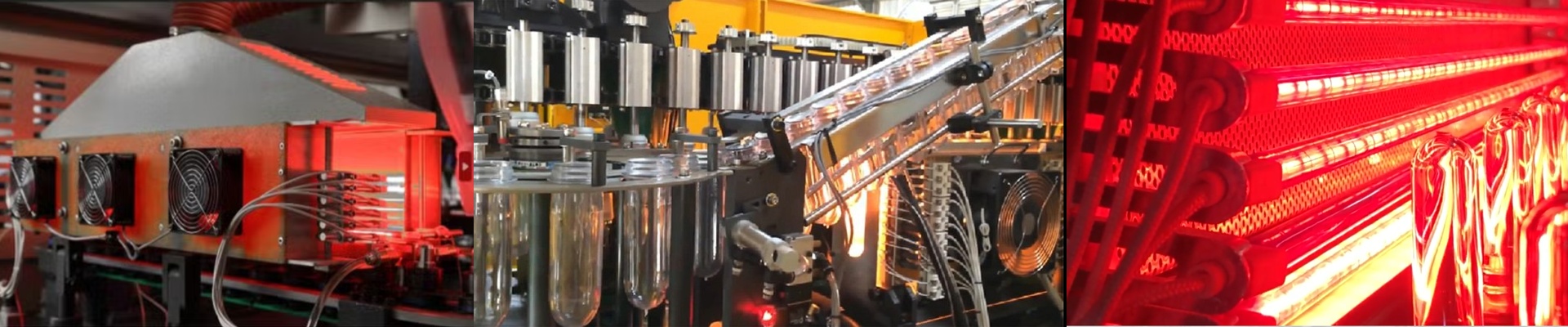
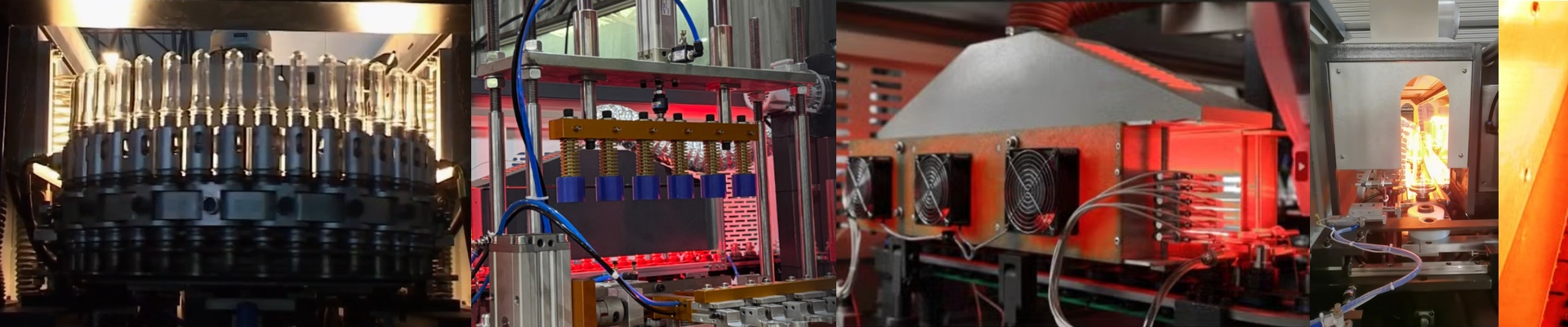
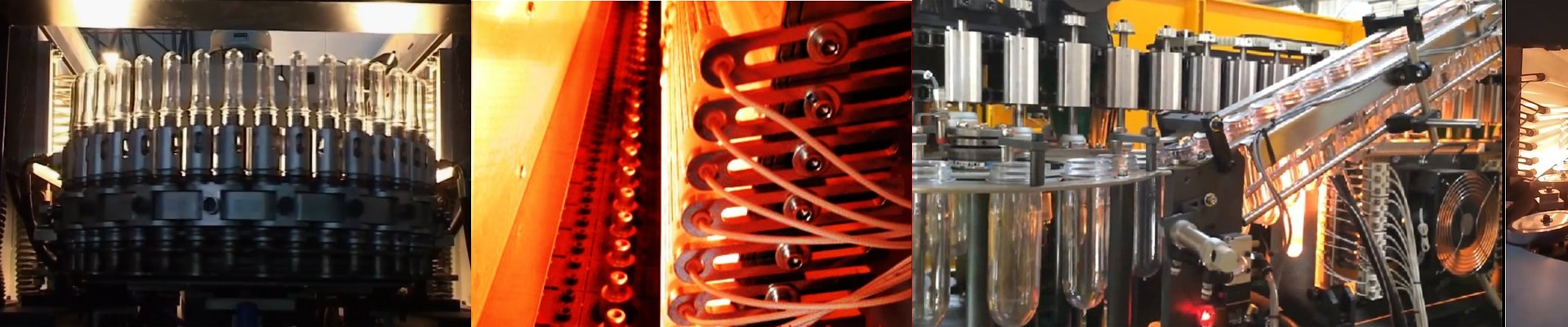
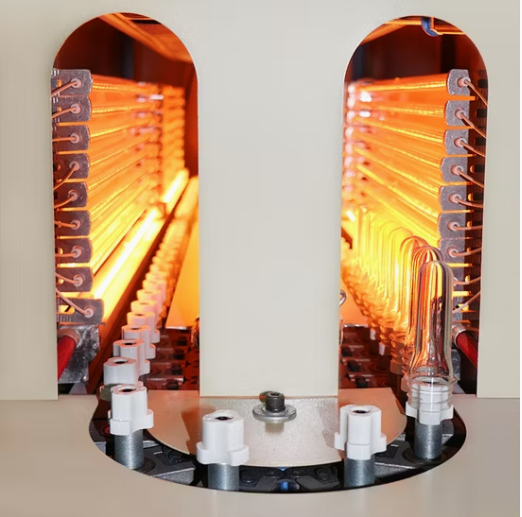
You see it on the line: preforms coming out of the heating tunnel looking chalky, almost white. The bottles that follow are weak at the base, hazy on the walls, and your scrap rate is climbing. In stretch blow molding, whitening isn’t just a cosmetic issue. It’s a clear sign the material isn’t hitting the right temperature profile before it hits the mold. More often than not, the root cause is right there in the heating system. As infrared emitters age, drift out of band, or lose output stability, the preform skin heats unevenly. The core never catches up. You get surface crystallization—whitening—and the process ends up fighting itself just to make a stable bottle. We work on infrared heating systems for blow molders, and we see this problem across Sidel, Krones, SIPA, Husky, SACMI, and Nissei ASB lines. The fix isn’t guesswork. It’s matching emitter technology and control to the preform geometry and the machine cycle.
What matters, technically
Infrared heating for PET preforms is a band-and-control game. If the wavelength and power density don’t line up with the PET absorption curve, you’ll spend all your time chasing temperature while the preform turns white.
- Wavelength selection: PET absorbs strongly in the short-wave and near-infrared bands. We run emitters in the 0.78–1.5 μm range, delivering fast, through-thickness heating that minimizes surface scorch and lowers whitening risk. This isn’t “brighter is better.” It’s matching the energy to the material physics.
- Power density and response: On a typical 28 mm preform, we target 2.5–4.0 kW/m² at the preform surface, adjusted for wall thickness and cycle time. The emitter has to hit temperature within 1–2 seconds. Slower ramp-up pushes you to raise tunnel temperature overall—and that’s where whitening and degradation start.
- Emitter types that fit the job:
- Quartz halogen: Fast thermal response, compact form, well-suited for short-wave output.
- Carbon fiber NIR: Broader band with strong coupling into PET, excellent for thicker walls and stable output over long runs.
- Control that holds temperature, not just power: PID with closed-loop feedback from a calibrated sensor keeps emitter output on target when line speed changes. Without it, you get overshoot on thin walls and undershoot on thick walls.
- Mechanical fit and connections: The heating tunnel is crowded and specific. We match the mounting footprint and connector types your machine expects, including R7s bases and quartz tube diameters common in blow molders. Lengths, wattages, and voltages are specified per station so you can replace one emitter at a time without re-engineering the tunnel.
- Output stability over life: We rate emitters for 5,000+ hours with less than 5% output drop. That matters because gradual loss quietly shifts the heating balance. You compensate by raising power, and the whitening comes back.
Why this works where it matters
Whitened preforms are often a symptom of mismatched heating—wrong emitter band, open-loop control, or aging lamps delivering less energy than your PLC thinks. When you run the right emitter in the right band, you get:
- Even heating, less surface crystallization: Short-wave and NIR energy penetrates faster, bringing the core up to stretch temperature without overheating the skin. Preforms stop looking chalky, and bottle clarity improves.
- Tighter process windows: With stable output and fast response, you can lower overall tunnel temperature and rely on precise emitter control. That cuts degradation and reduces whitening risk across different preform colors and additives.
- Fewer lamp changes, less downtime: Replacement intervals stretch from weeks to months. In a 24/7 plant, that means fewer interruptions, fewer recalibrations, and fewer chances for the heating profile to drift.
- Predictable energy use: Infrared heats the preform directly, not the air around it. When the control loop holds temperature, you stop chasing losses with brute-force power. Energy draw stabilizes, and you can predict it per thousand bottles.
- Compatibility with your blow molder: We build to the tunnel geometry and electrical interfaces of Sidel, Krones, SIPA, Husky, SACMI, and Nissei ASB machines. The changeover is a direct replacement, not a refit.
What you need to know on the floor
Replacing infrared emitters is straightforward, but real-world constraints matter.
- Match the connector and the length: An R7s base that looks similar can have different pin spacing and quartz tube length. Too long, and it contacts fixtures. Too short, and the beam pattern misses the preform. Check OEM dimensions and wattage per station.
- Keep an eye on the reflector: The reflector directs energy onto the preform. If it’s oxidized or pitted, output drops even with a new lamp. Replace reflectors at the same time as emitters, or you’ll be back to uneven heating and whitening.
- Alignment has to be clean: Emitters must point at the preform path with the correct focal distance. Misalignment creates hot and cold spots, and whitening shows up as streaks.
- Cooling and ventilation matter: Infrared systems need airflow to keep emitter temperature stable. Blocked vents raise emitter temperature, shift the output band, and shorten life.
- Calibrate the control: If your machine uses open-loop power control, consider adding a calibrated temperature sensor per zone. Closed-loop control keeps preform temperature where you want it, even when ambient conditions change.
- One practical trade-off: Short-wave emitters respond fast and run cooler at the preform than older halogen designs, but they’re sensitive to surface contamination. Keep the tunnel clean, or output will drift and you’ll see inconsistent heating and whitening. If your PET preforms are turning white, don’t chase the symptom by tweaking the mold or stretch ratio. Start in the heating tunnel. Match emitter wavelength and control to the preform, replace aging lamps and reflectors as a set, and align the beam. When the heat profile is right, the white disappears, scrap drops, and your blow molder runs the way it was designed. We can supply the exact emitter, connector, and control configuration your line needs. Tell us the machine model, preform size, and cycle speed. We’ll spec the lamps and set the control loop to hit the temperature profile that stops whitening for good.